I read an article in the Chronicle this morning about the tough time many non-profits are having getting donations from private donors. This isn't the case for all non-profits, though.

KALX is on track to break last year's record level for donations. I talked to Sandra earlier this evening and she said they are within $1,000 of their goal, with the rest of Friday night, all of Saturday, and part of Sunday still to go.
If you haven't donated, there's still time to pledge. You can call the station at (510) 642-KALX.
So why are donations to KALX rising while donations to many other non-profits are falling? Perhaps a backlash against the RIAA has led music lovers to send more of their money to support the broadcast of great, diverse music rather than lining the pockets of music label execs and industry organization stooges.
I just scored 3 out of 10 on a quiz where you decide based on a photo whether someone is a programming language inventor or a serial killer.
My first correct answer was for a photo of Phil Wadler. Since I know Phil and I used to work with him, one would hope that I would have correctly guessed that his co-designer role on Haskell qualified him as a programming language inventor. I picked up a lot of practical info on XML Schema and namespaces from Phil. I did not learn anything from him about garroting, impaling, or shooting.
The only serial killer I correctly identified was Sam Berkowitz (Son of Sam Killer). I guess I should stay out of dark alleys.
My final correct answer was a wild guess on a photo that turned out to be Ralph Griswold, the Snobol man. Although he definitely had the 1950's or 60's geek look going on in his photo, so did a couple other guys who turned out to have killed a lot more than just bugs.
[via Boing Boing: A Directory of Wonderful Things]

I watched the first half of A Beautiful Mind last night, and I can't help but think that John Nash might be an avid reader of Think Three magazine, "the leading periodical resource on RPS [Rock Paper Scissors] strategy, culture and style."
Never ones to shy away from controversy, the RPS society takes head-on the outlandish claims by heretics that dynamite should be allowed to sully the rock-paper-scissors trilogy.
Thanks, Paul!
Earlier I postulated that local TV reveals all you need to know about another culture. Okay, so if you don't buy that one, surely you will agree with me that hotel room minibar snacks are the key to unlocking the true nature of the people from other lands.
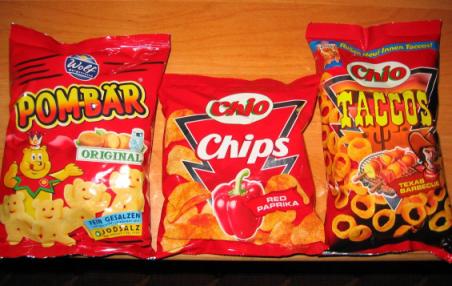
I found these fine, tasty snack treats in the minibar of our hotel in Munich, The Country Inn by the Frankfurter Ring. I cannot attest to the edibility of any of these delectable meal accompaniments, though I was strongly tempted to rip open the Texas Barbecue flavor Taccos.
Although I dare to attribute the selection of these items to someone from Germany, it's quite possible that someone else back in the home office in Minneapolis, Minnesota, USA, is the mastermind behind the offerings.
Tony Blair and David Blaine, or is that David Blair and Tony Blaine, were both diagnosed with and treated for an irregular heartbeat. Both were similarly diagnosed with, but not yet treated for, irregular decision making.
Although I will probably eventually replace my corrupted Windows XP install with a fresh install to run a small handful of apps, I had been planning to get my printer and scanner working under Red Hat Linux for quite some time. It turned out to be easier than I expected.
Epson Stylus Color 860 Printer
The simple answer is use CUPS, at least if you are running Red Hat 9 and are attaching directly to the printer via USB.
- Use the Printer System Switcher (in the System Settings menu) to switch from LPRng to CUPS
- Connect the printer via USB and make sure it is turned on
- Access the CUPS admin interface in a browser
- Click Manage Printers, then Add Printer
- Enter a name and description, and enter "localhost" for the location
- On the next page, select your printer connection, e.g., - USB Printer #1 (EPSON Stylus COLOR 860)
- On the next page, select - Epson
- On the next page, select the first entry that says - EPSON Stylus Color 860, CUPS+GIMP-print v4.2.4 (en)
You will obviously need to have CUPS and gimp-print installed for this to work. I'm pretty sure they were both part of the standard workstation install for Red Hat 9. If you can't access the CUPS admin interface, try restarting the CUPS daemon.
/etc/init.d/cups restart
Epson Perfection 1200S Scanner
The 1200S has a SCSI connection, since I bought it long ago for my Power Mac G3 desktop. Although Epson doesn't seem to be too keen on providing Linux support for their printers, they do at least point you to a program developed by the Epson Kowa corporation that supports Epson scanners on Linux. I'm not sure exactly how this company is related to Epson, but I already like them a whole lot.
Epson Kowa provides Image Scan! for Linux as a free download. It works with a lot of Linux distros and a lot of Epson scanners. I downloaded the gcc 3.2 experimental version rpm, installed it, restarted Red Hat (only because I didn't have the scanner turned on when I last booted up, which is a SCSI bus issue on Windows, too), followed the install instructions to add a symbolic link to the iscan executable to my GIMP plugins directory, fired up the GIMP, and started scanning photos. So far, Image Scan! has worked perfectly.

Global Elegies: Art and Ofrendas for the Dead is the title of the 10th annual Días de los Muertos exhibition at the Oakland Musem of California. Sandra and I went to see it today and I can highly recommend it.
This exhibit was a bit different than other Day of the Dead exhibits I've seen. The curator, Enrique Chagoya, included some interesting non-Latino works along with some great traditional and non-traditional Latino works. You've got your lobster-shaped coffin from Ghana, acrylic crosses embedded with ashes of an artist who died of AIDS, a terrarium (with projected video) containing live ants listening to electronic music and eating alfeñiques/calaveritas (sugar skulls), and a purple papier-mâché skull with a devil on top having several teeth removed by skeletons. How could you not get incredibly excited about an exhibit like this one?
The Oakland Museum store also has some great stuff, especially the items related to this show. We bought a very cool mirror that is surrounded by paintings based on prints by José Guadalupe Posada, my favorite printmaker.
Voxilla is a great source for info on new developments related to VoIP, SIP, and other relatively new communication related technologies. Jeff Pulver from Free World Dialup and Ravi Sakaria, CEO of VoicePulse, even have their own forums where they answer questions.
One of the areas generating controversy on the website involves the Skype hype. I fall into the category of people who found Skype really interesting at first, but then was a little less amazed by it when I realized how similar it was to other IP phone software that had preceded it. Nonetheless, it may be those few differences that allow Skype to grab a big market share quickly.
I was astonished when I first read on the Skype site about how quickly they developed Skype. The sound quality was just too good to have come out so quickly from a company with no experience in developing high performing codecs for VoIP. Well, it turns out they didn't write the codecs. That work appears to have been done by Global IP Sound. However, Skype did do a great job in using peer-to-peer technologies to simplify the use of VoIP.
I'm still impressed by Skype, but it's far more evolutionary than revolutionary. Definitely, the best thing about it is that it has helped to really raise the visibility of VoIP in the media, which can only help all the companies developing VoIP software and hardware.
The Plan - By the end of 2003, shift usage of home PC from mostly Windows to mostly Linux.
Windows XP forced my hand a little earlier than I had planned. As of late, I have probably been spending about a third of the time booted into Linux instead of XP. However, when I returned from vacation last week, my PC (Dell Dimension 4400) refused to boot into Windows. About halfway into the boot process, a small blue screen would appear for about quarter of a second and then disappear. Then I would get a screen offering me the option to boot into safe mode. Even in safe mode, no dice.
Fortunately, I had a stable operating system (Red Hat 9) installed on a second hard drive I had added about a year ago. I was able to boot into Linux successfully. After several more attempts to boot Windows, I decided that the data was most important and I gave up on getting Windows to boot.
A quick web search turned up an open source project for a Linux kernel driver for NTFS. Even better, the project supplied an RPM for Red Hat 9. Within about two minutes, I had downloaded the correct RPM, installed it, mounted the NTFS partition, and started copying the files to a Linux partition. WooHoo!
Goodbye, Windows. I knew ya entirely too well.
A couple of researchers from Carnegie Mellon and Hitachi have written a paper on an extension to VoiceXML to more easily support complex dialog systems. Their focus is on scenarios where you have multiple related dialogs and want to allow for flexible transitions between these dialogs. From the abstract:
This paper describes DialogXML, an extension to VoiceXML that supports a more implicitly declarative language for dialog scenarios, and ScenarioXML, a straightforward combination of DialogXML with the template-filling mechanism of Java Server Pages.
Essentially the same group also recently published a paper in the Information Processing Society of Japan SIG Notes on a spoken dialog management architecture for car telematics systems using VoiceXML, DialogXML, and ScenarioXML.
This is really interesting stuff, but I still struggle with the idea of using an XML-based language for programming. I really like the idea of being able to validate my code against a DTD or schema, but the code ends up being really verbose and hard to read. It's even worse than JSP or ASP coding. XML just doesn't seem like the most user friendly way to describe these kinds of state transition diagrams.
Whenever I travel, I always like to watch a bit of what the local TV channels are running since I believe that local television broadcasts can tell you a lot about the local culture. Okay, maybe not, but I like to give it a try anyway.
When I was in Munich last week, I caught dubbed reruns of Hogan's Heroes on TV several times. What the heck was that about? That would be like watching movies of John Wayne battling the "savage natives" on a Indian Reservation TV channel.
It's not like they had a jones for any American 1970's era slapstick comedy. There was no Gilligan's Island, Bewitched, or I Dream of Jeanie. Just Hogan's Heroes. Our friend in Munich said that Germans generally view Hogan's Heroes as especially funny because the stereotypes of Klink and Schultz are so over the top.
The Wikipedia article I linked to above ends with:
The show later became popular in Germany, with dubbed-in lines. In response to the sensitivities over Nazism, when German characters raised their arms and said "Heil Hitler" in the original version, the dubbed German version would replace that line with something ridiculous, such as "The wheat grows this high".
I wish I had read this beforehand, as I would have listened more carefully, not that my German is that good anyway.
It was close for a while, but I think that Tony Blair has taken a clear lead over George Bush in being most hated in his own nation. I was aware of some level of backlash against Blair before I got to London, but the English (possibly motivated by what's going on in California) are talking seriously of recalling him, or more likely getting him to step down. I can't imagine Davis or Bush facing the music and voluntarily abdicating.
When it comes to being hated in other nations, though, Bush is the clear winner. In my admittedly highly unscientific poll, Bush is the least popular world leader among people in England and Germany. Germany wasn't that much of a surprise, but I didn't expect Bush to be so widely despised and ridiculed in England.
